SS-31
SS-31 (elamipretide) is a small peptide that goes straight to the mitochondria, the parts of cells that make energy. In 2025 the FDA approved it as Forzinity for Barth syndrome, a rare inherited condition. Inside mitochondria, a fat called cardiolipin holds the energy-making machinery in place. SS-31 gathers there, and in lab studies it cut the leak that makes free radicals.
What it’s studied for
- Walking distanceStudied in humans
In a long-term trial in Barth syndrome, people walked about 96 meters farther in a 6-minute test. Only 8 people stayed in for the full three years. source
- Function with ageStudied in animals or lab
In aged animals, 8 weeks slowed frailty and partly restored heart and muscle function. Human results may differ. source
- Mitochondria shapeStudied in animals or lab
In aged animals, 8 weeks of SS-31 restored the inner folds of mitochondria in the kidney, heart and muscle. source
1 more use studied
- Fewer free radicalsStudied in animals or lab
In lab studies, it cut free-radical production by 40 to 60%. source
 New here? Three things worth knowing first
What’s a peptidepeptideA short chain of amino acids. Proteins are long chains; peptides are short ones, usually under 50 amino acids.? A short chain of amino acids, the building blocks of protein. Many act like messengers in the body.
Why the vial has to be mixed. It ships as a dry powder. You add bacteriostatic waterbacteriostatic waterSterile water with a little benzyl alcohol that stops bacteria growing, so a mixed vial lasts days or weeks. Often called BAC water., and the amount you add decides how many unitsunitsMarks on an insulin syringe. On a U-100 syringe, 100 units = 1 mL. How many units equal a dose depends on how much water was added. on the syringe equal one dose. The calculator does that math.
SubcutaneoussubcutaneousUnder the skin, into the fat layer. The usual route for peptide injections. Often shortened to sub-Q. injection, Once daily. Subcutaneous means into the fat layer just under the skin. It uses a small insulin syringe. Any word with a dotted underline on this page opens a short definition.
Dosage guidelines
Protocols describe 1 to 2 mg once a day for 4 to 8 weeks. The approved dose for Barth syndrome is much higher: 40 mg a day.
The doses below come from published reference protocols and, where they exist, the human trials. Tap a row to load it into the calculator.
Figures reviewed against their sources in October 2026. Where a trial or approved label sets a schedule, it is shown first; where a label sets one fixed dose, the FAQ below says so.
Repair protocol. 1 to 2 mg once a day for 4 to 8 weeks. No fasting or set time of day.
Age-related decline in otherwise healthy adults · 1–2 mg, once daily · 4–8 weeks
| Step | Dose per injection | Draw to | |
|---|---|---|---|
| 1 | 1,000 mcg (1 mg) | 20 units | |
| 2 | 2,000 mcg (2 mg) | 40 units |
Doses marked “between 5-unit marks” sit between the 5-unit lines on a 1 mL syringe; the 1-unit lines on a 0.5 mL or 0.3 mL syringe make them easier to read.
Units are for a 10 mg vial mixed with 2 mL of water. Change the vial in the calculator
Full protocol details
Other protocols described
- Clinical dose (Barth syndrome). 40 mg a day, long term, is the approved dose for Barth syndrome. Figures of 5 to 50 mg a day seen online are disease-level doses, not the repair protocol.
Mixing in the protocols: 10 mg vial + 2 mL bacteriostatic water · 500 mcg per 10 units; 1 mg per 20 units.
Repair protocol
Age-related decline in otherwise healthy adults
- Dose
- 1–2 mg
- How often
- Once daily
- Timing
- No fasting or set time
- Route
- Subcutaneous
- How long
- 4–8 weeks
Repair, then optimize
Adults about 35–55 with declining energy and slower recovery
- Dose
- 1–2 mg SS-31 daily, then MOTS-c
- How often
- SS-31 once daily; NAD+ 100 mg three times a week
- Timing
- No fasting
- Route
- Subcutaneous
- How long
- Weeks 1–4 (up to 8) SS-31 with NAD+; weeks 5–12 MOTS-c 10 mg a week split over three days, with NAD+
- Break
- 4–8 weeks fully off after the 12 weeks; repeated 2–3 times a year
Clinical dose (Barth syndrome)
The approved use
- Dose
- 40 mg
- How often
- Once daily
- Route
- Subcutaneous
- How long
- Long-term
Higher doses seen online, 5 to 50 mg a day, are disease-level figures rather than the repair protocol above.
Cycle
4–8 weeks
When a step up happens
User reports describe stepping up only after progress has stalled for two weeks or more, and only if the previous step was tolerated. Everyone is different.
Timing: No fasting or set time.
Peptide calculator
Already filled with this vial. Change anything you like.
How much is in your vial?
Check the label. The most common strengths:
Every 10 units = 1 mg.
10 units. 1 mL of BAC water
How the vial is mixed
The powder has to be dissolved in bacteriostatic (BAC) water before use. For a 10 mg vial this page uses 2 mL, which puts the usual dose on a round syringe mark: every 10 units is 500 mcg.
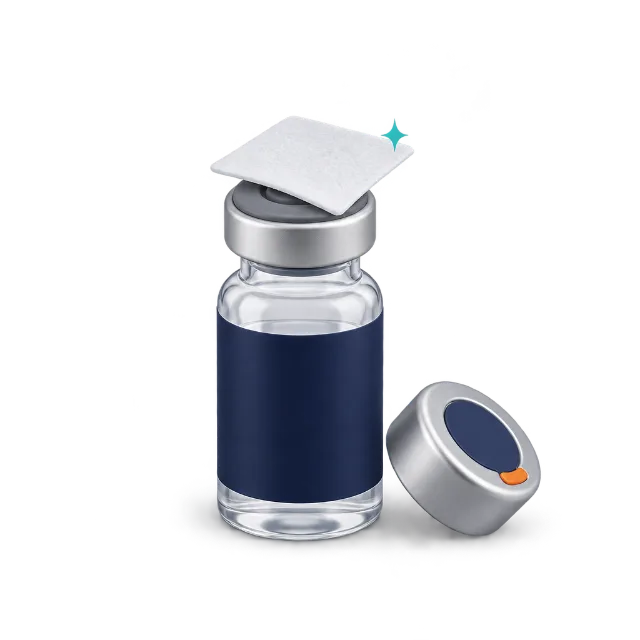 STEP 1Wipe both topsAlcohol pad on the peptide vial and the BAC water vial.
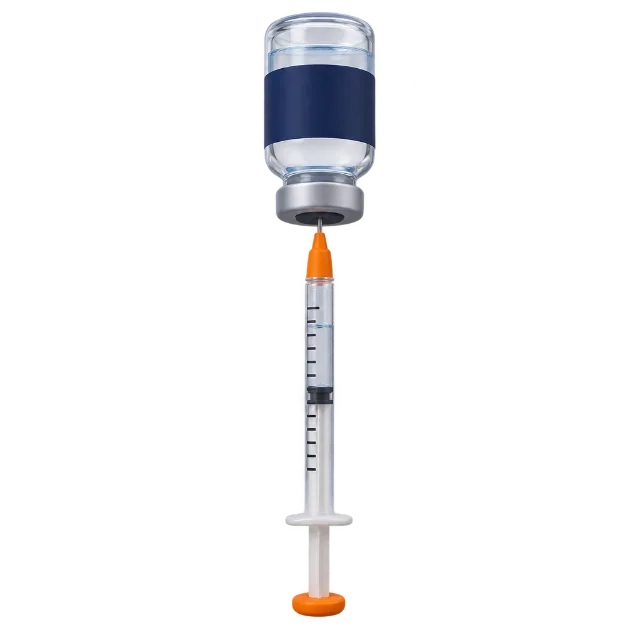 STEP 2Draw 2 mL of waterThat’s 2 full 1 mL syringes.
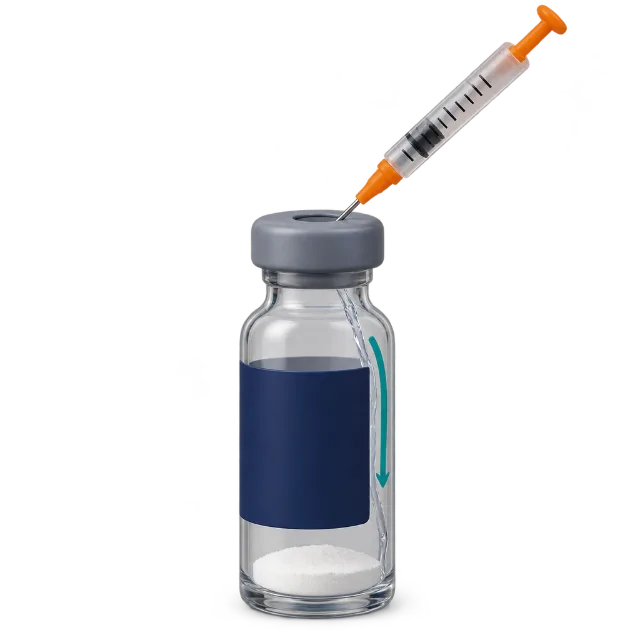 STEP 3Add it slowlyAim at the glass wall, not at the powder.
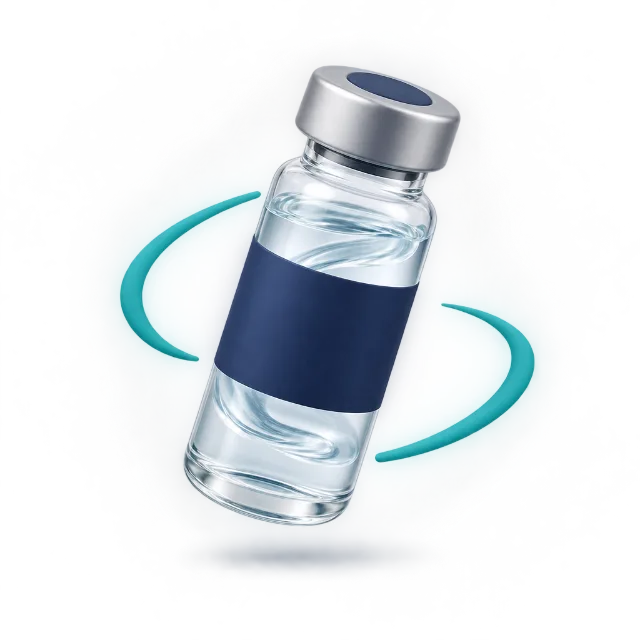 STEP 4Swirl, don’t shakeRoll gently until clear. Refrigerate after.
What to watch for
- Redness, itching or pain at the injection site, the most common side effectside effectAn unwanted effect that happens alongside the intended one.Studied in humans
- HivesStudied in humans
- Headache, now and thenStudied in humans
- Tiredness in the first few days, which users say passesReported by users
Not for anyone with severe kidney disease, since the kidneys clear it, or a known allergy to it. Not for anyone pregnant or breastfeeding, where safety data is thin. Talk to a doctor first, especially with kidney, heart or autoimmune conditions.
Reasons to get medical help right away: trouble breathing, swelling of the face or throat, chest pain, fainting, or any severe or worrying reaction.
Full side-effect list and who should avoid it
In published research
- Injection-site redness: 57%
- Itching: 47%
- Injection-site pain: 20%
- Hives: 20%
- Irritation: 10%
- Less common: headache, early fatigue, rare stomach upset
- No consistent serious drug-related events across trials, including more than 3 years of daily use in Barth syndrome
What users report
- Injection-site reactions are the main complaint and usually manageable
- Some describe tiredness in the first few days that passes
Not for
- Severe kidney disease (it is cleared entirely by the kidneys)
- Known allergy to the peptide
- Pregnancy or breastfeeding (not enough safety data)
Use caution with
- Mild to moderate kidney impairment
- Medicines that affect mitochondrial function
- Autoimmune conditions
- Heart conditions, where trials showed variable effects
How the body handles it
- Peak in the blood within 15 minutes after an injection under the skin
- Half-life about 2 hours
- Cleared 100% by the kidneys, with no liver processing
- Concentrates in mitochondria about 5,000 times above the surrounding cell
Supplies
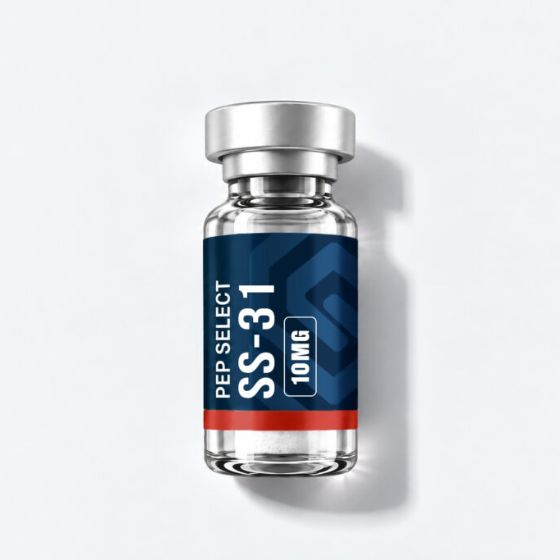
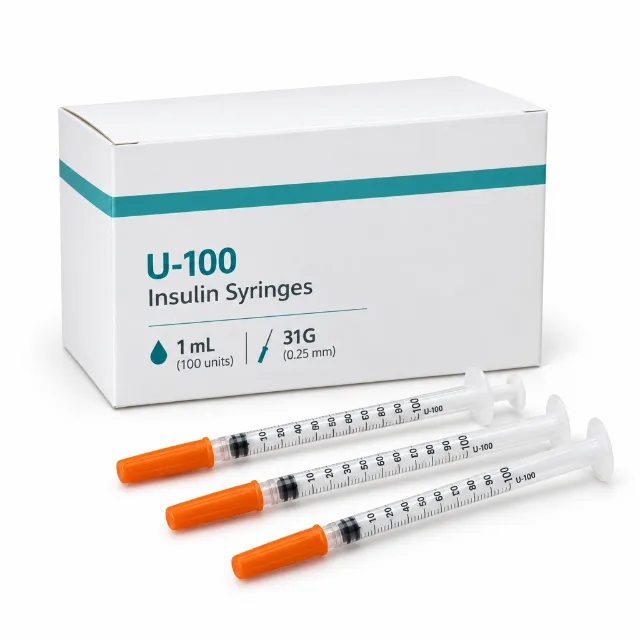
What 12 weeks of the schedule above takes, counted dose by dose.

By clicking this link, WikiPep may receive a commission.
Stacking
The community pairs SS-31 with NAD+ and MOTS-c, which are described as working on cell energy from other sides. None of these pairings has been tested in people.
- NAD+Reported by users
SS-31 is described as fixing the cell’s power plants, and NAD+ as the fuel they then use.
- MOTS-cReported by users
Often run after SS-31, once 4 to 8 weeks of repair are done. With milder decline, some run both at once.
Also used alongside it, with no interactions described: Epithalon and FOXO4-DRI, GLP-1 drugs, growth-hormone peptides, BPC-157 and TB-500.
Go deeper
Every study, community report and source behind this page.
What the studies show12 findings, each with its evidence label
Status, October 2026. Elamipretide (SS-31) received FDA accelerated approval on September 19, 2025 as Forzinity (Stealth BioTherapeutics, now part of Mighty Therapeutics) to improve muscle strength in people with Barth syndrome who weigh at least 30 kg. A confirmatory Phase 4 trial began in 2026. Source
How it works
Most of the body's ATP is made along a chain of protein complexes on the inner mitochondrial membrane. When electrons leak out of that chain they form free radicals, and leakage tends to rise with age.
A fat molecule called cardiolipin holds that chain in order and shapes the membrane's folds. It is found nowhere else in the body, and it is also the molecule free radicals damage first, which loosens the chain and lets more electrons leak.
SS-31 carries a positive charge and cardiolipin a negative one, so the peptidepeptideA short chain of amino acids. Proteins are long chains; peptides are short ones, usually under 50 amino acids. gathers where cardiolipin is. In lab studies it reached concentrations about 5,000 times higher inside mitochondria than in the surrounding cell within 15 minutes, stabilized cardiolipin, and cut free-radical production by 40 to 60%. Rather than mopping up free radicals after they form, as classic antioxidants do, it addresses the leak that produces them.
Benefits
Each one carries an evidence label, so you can see how much is actually known.
Mitochondrial structure
In aged animals, 8 weeks of SS-31 restored the internal folds of the mitochondria and reduced markers of cell aging in kidney, heart and muscle. It made existing mitochondria work better rather than making more of them. source
Energy and exercise capacity
In people with Barth syndrome, walking distance in a 6-minute test improved by about 96 meters over long-term treatment. source
Less oxidative stress
In lab studies, stabilizing cardiolipin cut free-radical production at its source by 40 to 60%. source
Heart, kidney, brain and muscle
Animal studies report protective effects across organs that depend most on mitochondria, especially the heart and kidneys. source
Function with age
In aged animals, 8 weeks of treatment slowed the build-up of frailty and partly restored heart function and muscle fatigue resistance. source
What the science shows
TAZPOWER, Barth syndrome (human, phase 2/3)
Studied in humans40 mg a day under the skin in 12 patients. The first 12-week crossover phase did not meet its main goals. source
TAZPOWER extension, 168 weeks (human)
Studied in humansOf 10 patients who entered, 8 reached week 168. Six-minute walk distance rose 96.1 meters (P = .003), leg strength by more than 45% and heart function by 45%, with cardiolipin levels improved. Injection-site reactions were the most common side effect. source
Kidneys in aged animals (2017)
Studied in animals or labAnimals at an age equivalent to 70–90 in humans were treated for 8 weeks. ATP production recovered, kidney filter cells looked healthier, and markers of cell aging fell. source
Heart and muscle in aged animals (2025)
Studied in animals or labEight weeks of elamipretide slowed frailty and partly restored heart and muscle function. Measures of biological age itself did not change, suggesting function can improve without a change in molecular age. source
Barth syndrome heart model (2024)
Studied in animals or labTreatment improved the shape of heart mitochondria and the cell's clean-up of damaged ones. source
Exercise tolerance in aged animals
Studied in animals or labTreatment improved the balance of free radicals and restored exercise tolerance. source
Heart failure and mitochondrial myopathy (human)
Studied in humansTrials showed improvement in some secondary measures, such as fatigue, but did not consistently meet their main goals. It was generally well tolerated. source
What the community reports4 user reports, a timeline and 4 pairings
What to expect
Peak level in the blood. Half-lifehalf-lifeHow long it takes for half of a compound to leave the body. A longer half-life usually means less frequent dosing. is about 2 hours, but the peptidepeptideA short chain of amino acids. Proteins are long chains; peptides are short ones, usually under 50 amino acids. stays in the mitochondria much longer.
Studied in humansUsers describe subtle gains in energy and recovery.
Reported by usersThe repair phase the protocols are built around.
Reported by usersThe protocols are described for adults over about 35 to 40 with declining energy and slower recovery. For younger, metabolically healthy people it is described as often unnecessary. Training, food and sleep are framed as the foundation it builds on.
What people report
Gathered from user communities. Anecdotal: useful for what to expect, not proof.
Energy and recovery
Steadier day-to-day energy and faster recovery from training, usually within 1–2 weeks, described as even rather than stimulant-like.
Subtle by nature
Many describe the effect as things simply working better rather than a distinct feeling.
Injection-site reactions
The most discussed side effectside effectAn unwanted effect that happens alongside the intended one.: redness, itching or welts that tend to fade with continued use.
Before MOTS-c and NAD+
People who ran SS-31 first describe getting more out of MOTS-c and NAD+ afterwards.
Stacking
How it is described alongside other compounds.
NAD+
Described as working together: SS-31 restores the machinery and NAD+ supplies the fuel it can then use.
MOTS-c
Run one after the other where damage is significant, SS-31 first for 4–8 weeks. For moderate decline, running both together is described as an option, because a 2026 study found the two lower free radicals by separate routes.
Epithalon and FOXO4-DRI
Described together as a longevity stack for people over 50, followed by MOTS-c and NAD+.
GLP-1 drugs, growth-hormone peptides, BPC-157, TB-500
No interaction concerns described. Growth-hormone peptides keep their own fasting schedule; SS-31 has none.
Common questions7 questions
Common questions
Why SS-31 before MOTS-c?
Where mitochondrial damage is significant, protocols put repair before optimization: MOTS-c signals cells to make more energy, SS-31 restores the structure that makes it. For moderate decline the two are also run together.
How quickly does it work?
It peaks in the blood within 15 minutes and has a half-life of about 2 hours. Users describe subtle changes in 1–2 weeks, with the repair phase running 4–8 weeks.
Why are injection-site reactions so common?
SS-31 can trigger a mild local histamine response. It is the most reported side effect in every trial, and it is usually mild.
Does NAD+ work without it?
It can, but turning NAD+ precursors into usable NAD+ itself takes ATP, which damaged mitochondria make poorly. That is the reasoning behind pairing the two.
Is it processed by the liver?
No. It is cleared entirely by the kidneys, which is why kidney disease is the main reason not to use it.
What does “minimum effective dose” mean?
It is the lowest dose that still produces the effect someone is after. User reports describe starting there and staying there for as long as it keeps working, rather than climbing toward the top of the range. Side effects tend to rise with dose, and the top of each range on this page is a ceiling people report, not a target.
When does the dose go up?
On its approved label (Forzinity, for Barth syndrome), elamipretide is used at one fixed dose of 40 mg a day with no step-up. The lower figures on this page come from research reference sites, not from a trial. User reports describe staying on a dose while it is still working rather than climbing toward the top of the range. There is no prize for getting to the top dose fast.
Source material10 studies and documents
References
- Szeto HH. Br J Pharmacol. 2014;171:2029-2050. pubmed.ncbi.nlm.nih.gov/24117165/…
- Thompson WR, et al. Genet Med. 2021;23:471-478. pubmed.ncbi.nlm.nih.gov/33077895/…
- Thompson WR, et al. Genet Med. 2024;26(7):101133. pubmed.ncbi.nlm.nih.gov/38602181/…
- Sweetwyne MT, et al. Kidney Int. 2017;91:1126-1145. pubmed.ncbi.nlm.nih.gov/28063595/…
- Mitchell W, Pharaoh G, et al. Aging Cell. 2025;24(6):e70026. pubmed.ncbi.nlm.nih.gov/40080911/…
- Machiraju P, et al. Sci Rep. 2024;14:13551. pubmed.ncbi.nlm.nih.gov/38866837/…
- Siegel MP, et al. Free Radic Biol Med. 2013;65:1234-1242. pmc.ncbi.nlm.nih.gov/articles/PMC6588449/…
- Birk AV, et al. J Am Soc Nephrol. 2013;24:1250-1261. pubmed.ncbi.nlm.nih.gov/23813215/…
- Gudiksen A, et al. Free Radic Biol Med. 2026;246:682-696. doi.org/10.1016/j.freeradbiomed.2026.01.002…
- Karaa A, et al. Neurology. 2023;101(3):e238-e252. pubmed.ncbi.nlm.nih.gov/37268435/…
Related
What is SS-31?
SS-31 is a small synthetic peptidepeptideA short chain of amino acids. Proteins are long chains; peptides are short ones, usually under 50 amino acids. built to reach the inner membrane of the mitochondria, the part of the cell that turns food into usable energy (ATP). Its drug name is elamipretide; the SS stands for its developers, Hazel Szeto and Peter Schiller. On September 19, 2025 the FDA granted it accelerated approval, as Forzinity, for Barth syndrome, a rare inherited condition affecting about 150 people in the US. It is the first approved treatment that targets mitochondria directly. A simple way to place it among the other mitochondrial compounds: NAD+ is described as the fuel, MOTS-c as the signal to make more energy, and SS-31 as the repair crew for the machinery itself.
What people look into SS-31 for
Every line carries an evidence label, so you can see how much is actually known.
Mitochondrial structure: In aged animals, 8 weeks of SS-31 restored the internal folds of the mitochondria and reduced markers of cell aging in kidney, heart and muscle. It made existing mitochondria work better rather than making more of them.source
Studied in animals or labEnergy and exercise capacity: In people with Barth syndrome, walking distance in a 6-minute test improved by about 96 meters over long-term treatment.source
Studied in humansLess oxidative stress: In lab studies, stabilizing cardiolipin cut free-radical production at its source by 40 to 60%.source
Studied in animals or labHeart, kidney, brain and muscle: Animal studies report protective effects across organs that depend most on mitochondria, especially the heart and kidneys.source
Studied in animals or labFunction with age: In aged animals, 8 weeks of treatment slowed the build-up of frailty and partly restored heart function and muscle fatigue resistance.source
Studied in animals or labMix and measure: a 10 mg vial
Go deeper
How it works, in plain words
Most of the body's ATP is made along a chain of protein complexes on the inner mitochondrial membrane. When electrons leak out of that chain they form free radicals, and leakage tends to rise with age.
What did the study measure?
No single study is featured for SS-31; the human trials are linked from the uses above.
Sources
Side effects and who should avoid it
Side effects and limits, stated plainly. If anything here applies to you, talk to a doctor first.