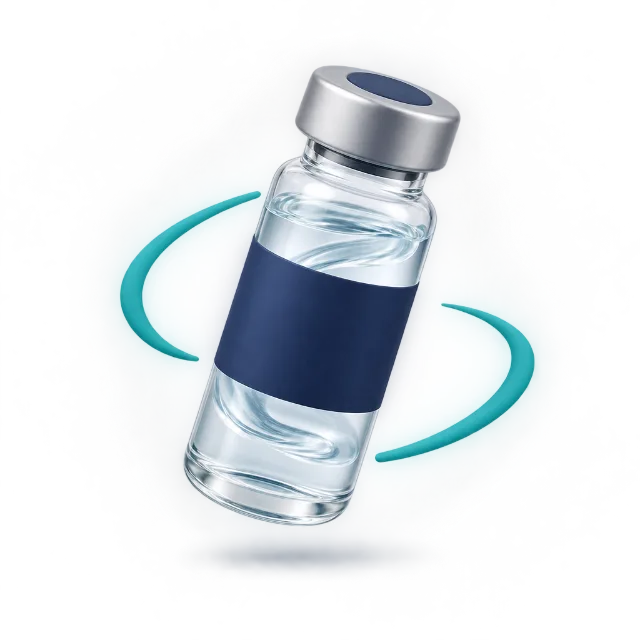
Bacteriostatic water or sterile water?
Bacteriostatic water is sterile water with 0.9% benzyl alcohol added. The alcohol stops bacteria from growing, which is why one vial can be drawn from many times. Its label calls it a multiple-dose product. Plain sterile water has no preservative and is meant for a single use, so once it has been opened it isn’t kept.
The bacteriostatic water label carries a boxed warning that it is not for use in newborns, because benzyl alcohol has been linked to toxicity in neonates.
Storing a mixed vial
Mixed peptides are kept in the fridge, at 2–8 °C (36–46 °F), away from light. Each compound page repeats this under its FAQs. Unopened bacteriostatic water is a room-temperature product (20–25 °C on its label).
How long a mixed vial lasts
There are two separate questions here.
- Sterility. Once a multiple-dose vial has been punctured, standard healthcare practice is to discard it within 28 days unless its manufacturer gives a different date, and straight away if sterility is in doubt. That is why step 4 says to write the date on the label.
- Whether the peptide is still intact. For most unapproved peptides this has not been measured in published studies, so there is no reliable number to give. The 28 days is about contamination, not about the peptide.
If the liquid is cloudy
A properly mixed peptide is clear. Cloudiness, floating particles or a change of color are signs that something is wrong. Injectable labels, including the bacteriostatic water label itself, say not to use a solution that is not clear.
If too much water went in
Nothing is lost. The same amount of peptide is in the vial; it is just more dilute, so each dose takes more units on the syringe. The calculator takes the vial size and the actual amount of water and works out the new number of units. The one practical limit is a 1 mL syringe: past 100 units a dose no longer fits in one draw.
mg, mcg and units
1 mg is 1,000 mcg. “Units” on an insulin syringe are a volume, not an amount of drug: on a U-100 syringe, 100 units is 1 mL, so 10 units is 0.1 mL. How much peptide those 10 units hold depends entirely on how much water went into the vial. IU (international units) are something else again, a measure of biological activity, and can’t be converted to mg without the product’s own figure.